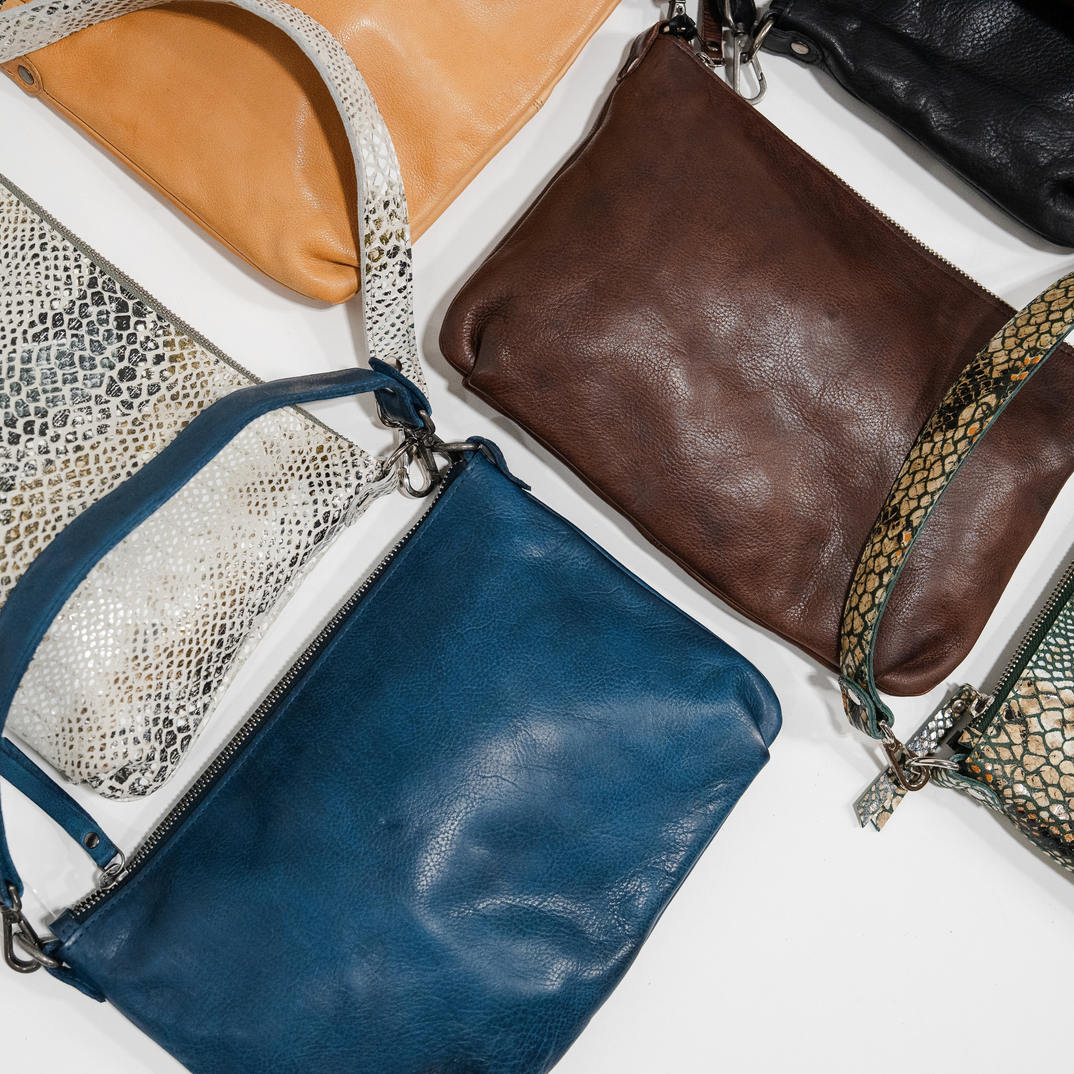

 Cognac
 Black
Black Oat
Oat Brown
Brown Cafe
Cafe Walnut
 Eggplant
 Oxblood
 Burgundy
 Aubergine
 Tan
Tan Hazel
Hazel Blush
Blush Camel
Camel Red
Red Orange
 Natural
 Burnt Orange
 Poppy
Poppy Plum
Plum Rosa
Rosa White
White Grey
Grey Cobra
Cobra Denim
Denim Indigo
 Emerald
 Teal
Teal Turquoise
 Sky Blue
 Grass
Grass Green
Green Olive
Olive Yellow
 Lemon
Lemon Honey
Honey Chartreuse
 Mustard
 Lavender
 Mint
Mint Foil Burgundy
 Foil Cream
 Foil Cobra
 Foil Desert Trail
 Foil Black
 Foil Sea Glass
 Foil Turquoise
 Foil Sunflower
 Foil Brown
 Foil Chartreuse
 Foil Red
 Foil Berry
 Foil Purple
 Foil Steel
 Foil Teal
 Hair On Black
 Hair On Brown
Article: Is a Duffle Bag a Carry-On? Sizes, Airline Rules, and What Actually Fits
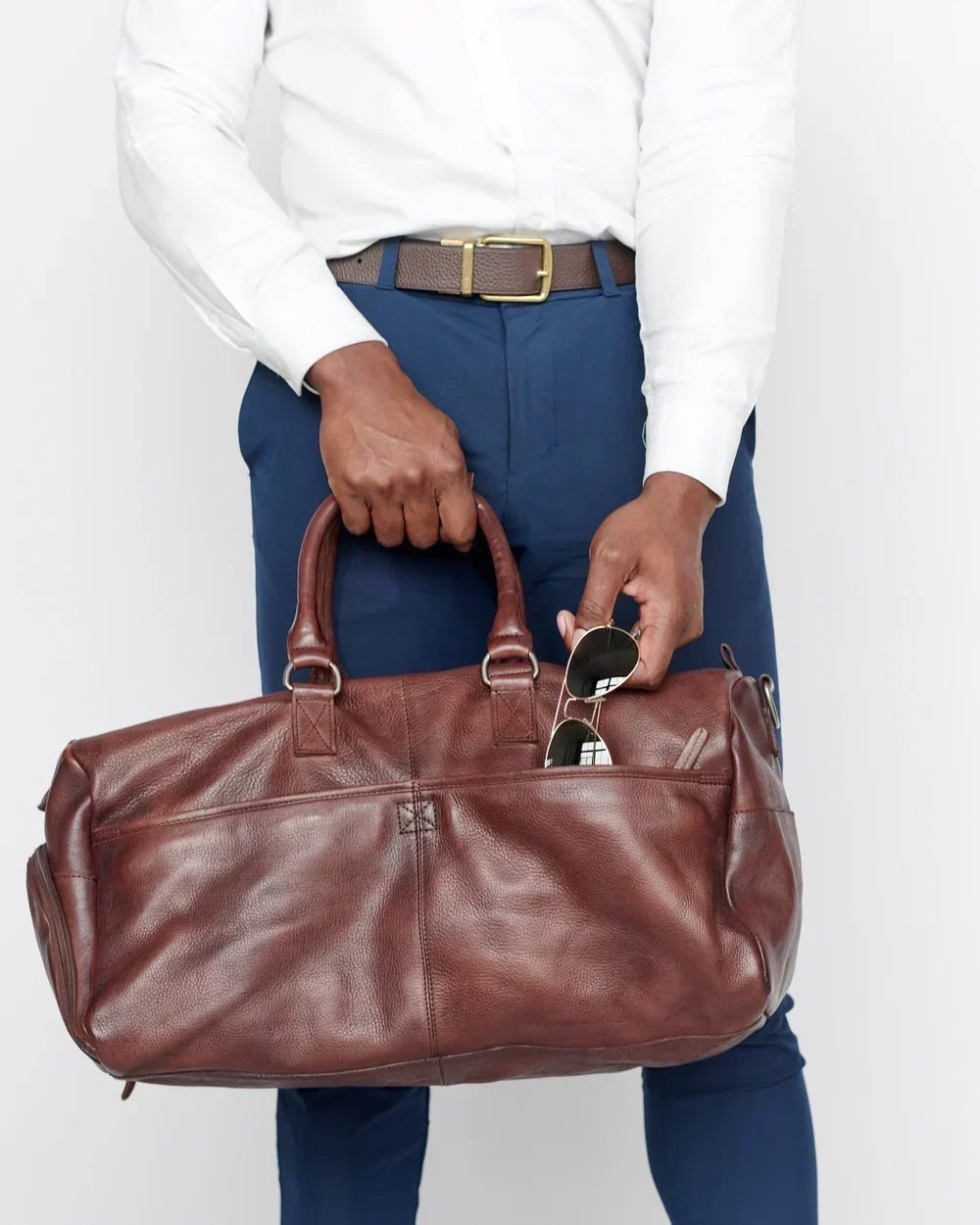
Is a Duffle Bag a Carry-On? Sizes, Airline Rules, and What Actually Fits
The flight is booked, the duffle is sitting by the door, and one question stands between you and the boarding line: will the gate agent wave it through? It deserves a straight answer, because it decides whether you stroll to your seat or stop at the sizer.
The short version is reassuring. Most travel duffles clear airline cabin rules with room to spare. The longer version involves a few numbers worth knowing before you pack, and they take about ten minutes to learn.

Is a Duffle Bag a Carry-On?
Yes. A duffle bag is a carry-on whenever it fits your airline's cabin dimensions. Airlines measure dimensions, not bag types, so a duffle, a roller, and a hard-shell suitcase all pass or fail on the same numbers.
Most US carriers set the carry-on limit at 22 x 14 x 9 inches (56 x 36 x 23 cm), measured with handles, wheels, and exterior pockets included. The personal item allowance, the bag that rides under the seat in front of you, typically falls between 17 x 10 x 9 and 18 x 14 x 8 inches.
If you think in liters, a 30L to 40L duffle usually lands inside carry-on limits, and anything under about 20L reads as a personal item. Our leather duffles publish exact external dimensions on every product page, which makes the comparison a thirty-second job.
A duffle is soft-sided, so its size changes with how it's packed. A bag that measures compliant empty can bulge past the limit at the gate.
Carry-On vs. Personal Item: Where a Duffle Falls
The two allowances are defined by where the bag rides, and the names follow from there. A carry-on goes in the overhead bin. A personal item slides under the seat in front of you.
Most travelers get one of each, and a duffle can serve as either depending on its size. The practical dividing line sits around 18 inches: a duffle 18 inches long or shorter usually clears the under-seat space, while 19 to 22 inches is overhead bin territory.
Ignore the marketing labels while you measure. "Gym duffle" and "travel duffle" describe a vibe, and airlines have never once measured a vibe. A small travel duffle can be a personal item, and an oversized gym bag can fail the carry-on sizer.
When a Duffle Works Better as Your Personal Item
Here's a pairing that seasoned travelers swear by: a roller in the bin, and a compact duffle under the seat with everything you'll touch mid-flight. Boarding pass, laptop, a change of clothes, toiletries, and headphones all stay within reach instead of six rows back.
Under-seat space varies by aircraft and even by row. Bulkhead seats often have no under-seat storage at all, and window seats on some aircraft give up a few inches to the fuselage curve. A softer, shorter duffle handles that variability better than a rigid case.
If you're building that two-bag setup, our guide to the best leather crossbody bags for travel covers the even smaller companion piece, the bag that stays on you after both are stowed.
Airline Carry-On Size Rules, Compared
The numbers below reflect each carrier's published policy as of this writing. Airlines adjust these occasionally, so confirm on your carrier's baggage page before a trip.
| Airline | Carry-on limit | Personal item | Worth knowing |
|---|---|---|---|
| American | 22 x 14 x 9 in | 18 x 14 x 8 in | Carry-on included on every fare, basic economy too |
| Delta | 22 x 14 x 9 in | Fits under the seat (no published size) | Basic Economy still includes a full carry-on on domestic routes |
| United | 22 x 14 x 9 in | 17 x 10 x 9 in | Domestic basic economy includes a personal item only |
| Southwest | 24 x 16 x 10 in | 16.25 x 13.5 x 8 in | Ties Frontier for the biggest carry-on dimensions, with no fee attached |
| JetBlue | 22 x 14 x 9 in | 17 x 13 x 8 in | Every fare includes a carry-on, though the cheapest tier boards last |
| Alaska | 22 x 14 x 9 in | Fits under the seat (no published size) | Carry-on and personal item included on every fare |
| Frontier | 24 x 16 x 10 in | 18 x 14 x 8 in | Same generous dimensions as Southwest, but the carry-on is a paid add-on outside its fare bundles |
Two patterns in that table do most of the work. First, 22 x 14 x 9 clears every major US carrier, which is why it's the number to pack against. Second, most US airlines publish size limits without weight limits, while many international carriers cap cabin bags at roughly 15 to 22 pounds (7 to 10 kg).
Enforcement is where published rules meet real life. Size limits live on a webpage, but they get applied at the gate via a metal bag sizer, and budget carriers use theirs far more consistently than legacy airlines do.
The rule that matters most on a multi-leg trip: the smallest allowance on your itinerary governs the whole thing, connections included. And on regional jets with small bins, even a compliant bag may get valet-tagged at the jet bridge, so keep your valuables in a smaller bag you can pull out.
What TSA Does and Doesn't Control
TSA screens what's inside your bag. Airlines decide how big the bag can be. Those are two different checkpoints run by two different organizations, and mixing them up causes most of the confusion around this topic.
So yes, TSA allows duffle bags. Bag shape has never been a screening concern. Liquids over 3.4 ounces, loose lithium batteries in checked luggage, and prohibited items are TSA's territory. Dimensions and weight belong to your airline.
How Duffle Sizes Are Measured (and Where People Get It Wrong)
Duffle listings usually quote length first, unlike suitcases, which lead with height. A "21-inch duffle" is 21 inches end to end. Read all three numbers rather than assuming the order.
Airline limits refer to external dimensions. Handles, metal feet, and exterior pockets all count toward the measurement, which is why a bag's packed profile matters more than its label.
Liters and inches also measure different things. Capacity is volume; airline limits are linear. A 40L duffle shaped long and flat can pass the sizer while a boxier 40L fails, which is why a 45L bag might squeak through half-packed and a 50L almost never will. The 45-linear-inch figure some airlines quote is simply length, width, and height added together.
Then there's the soft-sided variable. The same duffle measures differently empty, packed, and overpacked. The practical fix: pack your bag the way you'll fly with it, stand it upright, and measure it at its widest points. That number is the one the sizer sees.

Structured vs. Unstructured Duffles
Structure is the trade-off at the heart of the category. A duffle with a firm base and reinforced ends holds a predictable shape and passes a sizer reliably, while a fully collapsible duffle squeezes into a tight bin but bulges wherever the packing pushes.
Leather sits naturally on the structured end. The material holds its shape, and well-made leather duffles reinforce the base with a board and protective metal feet. Our Cabin Duffel is a working example: 21" L x 12" H x 9" D and 3.55 pounds, published right on the page, with an inch or more of clearance inside the 22 x 14 x 9 standard.

On the compact end, the Charleston Duffel measures 18" L x 10" H x 8" D with a hidden interior board that keeps the base flat. At that length it clears overhead bins easily and sits near personal-item scale on the more generous carriers.
That level of specificity is what you want from any brand, ours or anyone's. A bag sold with exact external dimensions and an empty weight can be checked against a limit before you buy. A bag sold as "carry-on friendly" with no numbers is asking you to find out at the gate.
What Actually Fits Inside a Carry-On Duffle
A 21-inch leather duffle holds more than most people expect, because a single open cavity wastes less space than a hard shell's molded interior. For a weekend of two or three days, that means three tops, two bottoms, one layer, a second pair of shoes, a toiletry kit, and a laptop.
A four-day long weekend fits by adding a top and swapping bulk for versatility: one jacket that works with everything instead of two that don't. A full week works if there's laundry access at the other end. Past that, you're in checked-bag territory no matter what the bag is made of.
The one-cavity design cuts both ways. You get more usable volume than a hardside of the same dimensions and less built-in organization. Packing cubes solve it: roll your clothes, cube them by category, and slot shoes at the ends of the bag where the curve wastes space anyway. A couple of travel kits corral toiletries and cables so the main compartment stays for clothes.
A leather duffle typically weighs 3 to 4.5 pounds empty, so on international routes with a 15-to-22-pound cabin allowance, that's the starting math before you pack. Exterior pockets and interior organizers also trade a little main-compartment volume for a lot of findability, a trade most travelers happily make.
Packing to Pass the Sizer
A duffle passes the sizer on its profile, so pack toward a rectangle. Distribute clothes flat and even across the length, keep dense items like shoes and toiletry kits low and centered, and stop before the top domes.
Underfilling fails too, in its own way. A half-empty soft duffle slumps and spreads sideways, which can push the width past spec even when the contents are minimal. If you're traveling that light, cinch the load with cubes or size down the bag.
For the layer-by-layer method, our handbag packing guide walks through the same principles at everyday scale, and they transfer directly to a duffle.
Choosing a Travel Duffle You Can Actually Fly With
This is a checklist to run against any bag on your shortlist, whoever makes it.
- Published external dimensions in inches: Since airline limits are linear and liters won't tell you enough
- Shape retention: A firm base, reinforced ends, and protective feet
- Carry system: Dual top handles plus a removable, padded shoulder strap
- Opening style: An extended or U-shaped top zipper beats a partial opening when you're retrieving one item in a cramped cabin
- Empty weight: Especially against international weight caps
- Hardware and stitching quality: Because overhead bins are not gentle
Our Las Vegas Weekender shows what those criteria look like filled in: 21" L x 12" H x 9" D, 4.25 pounds, a detachable padded strap, and a lined front compartment with dividers that lets one bag cover the Friday meeting and the Saturday getaway.
For longer trips, the Deluxe Travel Bag stretches to 22 inches with six exterior zip pockets and a wide U-shaped opening, sized for the week away rather than the overnight run. Duffles also skew toward the men on your gift list, and our men's collection carries the travel pieces that land best there.
Material belongs in the decision as a trade-off rather than a ranking. Leather brings shape retention and a patina that deepens with every trip; technical nylon brings compressibility. Pick the trade that matches how you travel.
If you're still deciding between the weekender and duffle formats themselves, our weekender vs. duffel comparison settles that category question in full. This guide stays on airline fit.
Common Carry-On Duffle Mistakes
- Assuming a bag marketed as "carry-on" is compliant on every airline
- Measuring the bag empty instead of packed
- Overstuffing end pockets, which pushes the width out of spec
- Forgetting the regional jet on your connecting leg
- Missing the weight limit on international carriers
- Treating an attached shoulder strap as exempt from the measurement
- Flying basic economy with no under-seat backup when the fare includes a personal item only
Quick Answers Before You Board
- Is a 45L duffel a carry-on? Sometimes. It depends on the bag's shape and how full it is, which is why linear dimensions beat liters for this decision.
- Is a 50L duffel too big? For the overhead bin, almost always. That's a checked-bag or road-trip size.
- Can I bring a suitcase as my carry-on and a duffle as my personal item? Yes, if the duffle fits under the seat, and it's one of the best two-bag setups going.
- Does a duffel count as a personal item? A compact one does. Around 18 inches or shorter is the working threshold on most carriers.
- Can I use a 28-inch duffel as a carry-on? No. At 28 inches it exceeds every US carrier's length limit and will be gate-checked.
One Measurement Settles the Question
Pack the bag the way you'll fly with it, measure it standing, and compare that number to the smallest allowance on your itinerary. That single habit answers the carry-on question for every trip, every airline, every bag you'll ever own.
A structured leather duffle makes the habit easy to keep, because it measures the same on your floor and in the sizer. Buy against published dimensions, pack to a rectangle, and the gate becomes the least interesting part of your travel day.