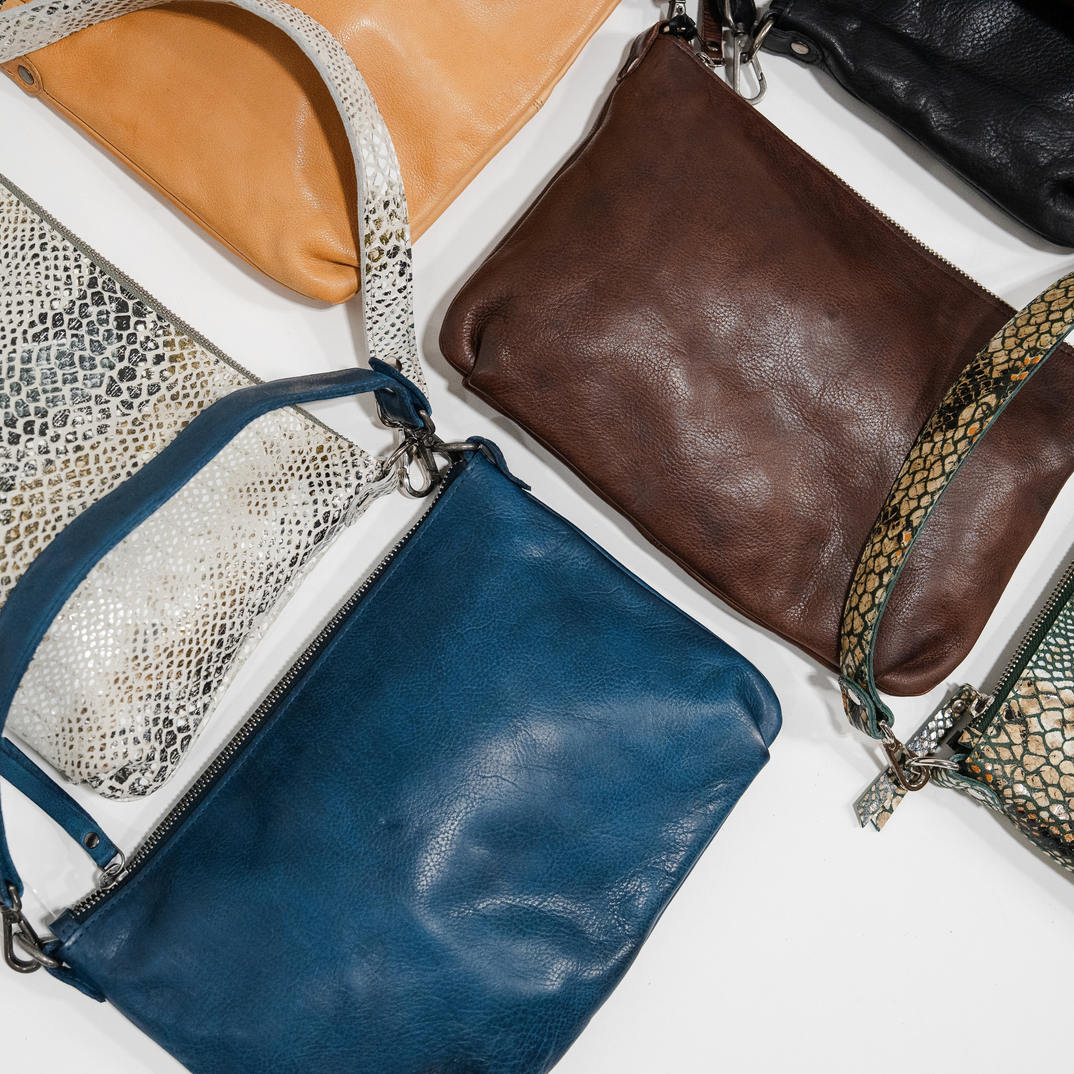
 Cognac
 Black
Black Oat
Oat Brown
Brown Cafe
Cafe Walnut
 Eggplant
 Oxblood
 Burgundy
 Aubergine
 Tan
Tan Hazel
Hazel Blush
Blush Camel
Camel Red
Red Orange
 Natural
 Burnt Orange
 Poppy
Poppy Plum
Plum Rosa
Rosa White
White Grey
Grey Cobra
Cobra Denim
Denim Indigo
 Emerald
 Teal
Teal Turquoise
 Sky Blue
 Grass
Grass Green
Green Olive
Olive Yellow
 Lemon
Lemon Honey
Honey Chartreuse
 Mustard
 Lavender
 Mint
Mint Foil Burgundy
 Foil Cream
 Foil Cobra
 Foil Desert Trail
 Foil Black
 Foil Sea Glass
 Foil Turquoise
 Foil Sunflower
 Foil Brown
 Foil Chartreuse
 Foil Red
 Foil Berry
 Foil Purple
 Foil Steel
 Foil Teal
 Hair On Black
 Hair On Brown
Anniversary Gifts by Year: Traditional and Modern, Explained
Every wedding anniversary has a gift theme attached to it: paper for the first year, wood for the fifth, silver for the twenty-fifth. Two separate lists assign those themes, and the fastest route to a confident gift is knowing how the two work.
This guide lays out anniversary gifts by year in one table, covering the traditional and modern lists plus the gemstone and flower systems that run alongside them.
Traditional vs. Modern Anniversary Gifts
The traditional anniversary gift list grew out of nineteenth-century custom. Victorian-era couples marked early years with paper, cotton, and leather, and the materials grew more durable as the years of marriage stacked up. Emily Post formalized a short version, eight milestone years, in her 1922 etiquette guide.
The modern anniversary gift list arrived in 1937, when the American National Retail Jeweler Association published themes for nearly every year. It leans toward jewelry, clocks, and household goods, which reflects who compiled it.
The two lists run in parallel. Both apply to the same year, so a third wedding anniversary can be marked with leather from the traditional list or crystal from the modern one.
The UK and US lists also differ at several years: the UK gives salt at year eight where the US gives bronze. This guide uses the US lists and flags UK differences where they change the answer.
The Complete Anniversary Gift List, Year by Year
The table below consolidates the gift themes by year, covering years 1 through 30 plus every five-year milestone anniversary through 75. Gemstone and flower columns are included because both systems get searched and gifted on their own, and most guides leave them out.
| Year | Traditional | Modern | Gemstone | Flower |
|---|---|---|---|---|
| 1 | Paper | Clocks | Gold jewelry | Carnation |
| 2 | Cotton | China | Garnet | Cosmos |
| 3 | Leather | Crystal or glass | Pearl | Sunflower |
| 4 | Fruit and flowers (UK: linen) | Appliances | Blue topaz | Geranium |
| 5 | Wood | Silverware | Sapphire | Daisy |
| 6 | Candy or iron | Wood | Amethyst | Calla lily |
| 7 | Wool or copper | Desk sets | Onyx | Freesia |
| 8 | Bronze (UK: salt) | Linen or lace | Tourmaline | Clematis |
| 9 | Pottery or willow | Leather | Lapis lazuli | Poppy |
| 10 | Tin or aluminum | Diamond jewelry | Diamond | Daffodil |
| 11 | Steel | Fashion jewelry | Turquoise | Morning glory |
| 12 | Silk | Pearls | Jade | Peony |
| 13 | Lace | Textiles or furs | Citrine | Chrysanthemum |
| 14 | Ivory (symbolic only) | Gold jewelry | Opal | Dahlia |
| 15 | Crystal | Watches | Ruby | Rose |
| 16 | – | Silver holloware | Peridot | – |
| 17 | Furniture | Furniture | Carnelian | – |
| 18 | Porcelain | Porcelain | Cat's eye | – |
| 19 | Bronze | Bronze | Aquamarine | – |
| 20 | China | Platinum | Emerald | Aster |
| 21 | Brass or nickel | Brass or nickel | Iolite | – |
| 22 | Copper | Copper | Spinel | – |
| 23 | Silver plate | Silver plate | Imperial topaz | – |
| 24 | Opal | Musical instruments | Tanzanite | – |
| 25 | Silver | Silver | Silver | Iris |
| 26 | Pictures | Original pictures | – | – |
| 27 | Sculpture | Sculpture | – | – |
| 28 | Orchids | Orchids | – | Orchid |
| 29 | New furniture | New furniture | – | – |
| 30 | Pearl | Diamond | Pearl | Lily |
| 35 | Coral (symbolic only) | Jade | Coral | – |
| 40 | Ruby | Ruby | Ruby | Gladiolus |
| 45 | Sapphire | Sapphire | Sapphire | – |
| 50 | Gold | Gold | Gold | Yellow rose |
| 55 | Emerald | Emerald | Alexandrite | – |
| 60 | Diamond | Diamond | Diamond | Orchid |
| 65 | Blue sapphire | Blue sapphire | Blue spinel | – |
| 70 | Platinum | Platinum | Platinum | – |
| 75 | Diamond or gold | Diamond or gold | Diamond | – |
The sharpest splits between the traditional and modern list land early. Year 1 gives paper or clocks, year 8 gives bronze or linen and lace, and year 10 gives tin or diamond jewelry. Those are the years where gift-givers stall.
The lists converge at the years that matter most. Silver marks 25 years and gold marks 50 on both, so the choice is moot at the biggest milestones. Years 26 through 29 have almost no gemstone or flower most sources agree on, which is why those cells sit mostly empty.
Years 1–10: The Early Materials
The first decade follows a deliberate arc. Paper, cotton, leather, flowers, wood: each material is sturdier than the last, the way an early marriage firms up year over year.
Leather appears twice in this range, and that trips up more gift-givers than anything else on the list. Year 3 is leather on the traditional list, and year 9 is leather on the US modern list. Both are legitimate leather years, which is why leather anniversary gifts get bought across two different anniversaries.
The modern list's substitutions make sense in their 1937 retail context. Clocks, appliances, and silverware were the aspirational household purchases of the era, so the association swapped them in where the older materials felt quaint.
Years 11–25: The Transition to Precious Materials
The second stretch moves the wedding anniversary out of the household and toward the heirloom. Steel, silk, and lace give way to crystal at 15, china at 20, and silver at 25, the first material both lists agree deserves a quarter of a century.
Year 14 needs a note. The traditional list assigns ivory, and the standard substitution is anything ivory-colored: cream leather, bone china, white gold. Nobody sources the real material, and no current list suggests it.
The modern list turns jewelry-heavy through this range: fashion jewelry at 11, pearls at 12, gold jewelry at 14, watches at 15. A jewelers' trade group compiled it, and the emphasis shows.
Years 30 and Beyond: Milestone Years
Past 30, the anniversary theme shifts to gems and precious metals at five-year intervals: pearl, coral, ruby, sapphire, gold, emerald, diamond. The wider spacing marks each one as a milestone anniversary in its own right.
These are also the years when the gift gains weight. A fortieth calls for something more considered than a fourth, and the pieces in our luxe gifts edit are chosen with those bigger years in mind.
Beyond year 60 the lists thin out. The 65th, 70th, and 75th have themes, but traditions turn regional and most couples default to diamond and gold.
What the Materials Actually Symbolize
The symbolism is the reason the list survived a century of changing taste. Each material makes a small claim about the marriage at that stage, and gift-givers still use those claims to explain a choice to a spouse or partner.
- Paper. The blank first chapter, a marriage still being written.
- Cotton. Comfort and adaptability, threads woven together.
- Wood. The fifth year as a rooted foundation.
- Crystal. At fifteen, it stands for clarity.
- Silver and gold. They close the arc with endurance and accumulated value.
- Leather. Strength and durability, and the material backs the claim physically. Full-grain leather records its use: it softens where hands hold it, darkens along the strap, and develops patina that deepens with every year of carrying. That behavior is what suits leather to an anniversary. The bags we've handcrafted since 1984 age visibly, and the visible aging keeps marking time long after the gift is given.
Some of these meanings are old, and some were written by retailers after the fact. Paper, wood, silver, and gold carry symbolism documented back to the nineteenth century.
The meanings attached to appliances, desk sets, and much of the jewelry sequence arrived with the 1937 list and served the people who published it. Treat the early symbolism as inherited and the later symbolism as assigned.
How to Choose Between the Traditional and Modern List
Match the list to how the recipient relates to objects. A partner who keeps ticket stubs and rereads old cards will feel the traditional list's symbolism. A partner who wants things in daily use is better served by the modern list's practicality.
Four questions settle most cases:
- Does the recipient value symbolism or utility?
- Is the gift for display or for daily use?
- Have earlier anniversaries followed one list already?
- Is the gift joint or individual?
The third question carries the most weight. Switching lists mid-marriage breaks the continuity that gives the tradition its meaning, so a couple that started traditional should stay traditional at least through the milestone years.
The hybrid approach keeps the symbolism and adds the utility. Keep the traditional material and choose a contemporary form for it: year 3 leather as a carried bag or a wallet that fits their style, year 15 crystal as glassware the couple will pour from.
Budget belongs in the decision too. The inexpensive-material years reward craftsmanship over spend: a well-made paper, cotton, or leather gift lands harder than an expensive one chosen off-theme, and plenty of strong options sit among gifts under $200.
Some couples ignore the lists entirely. The year's material is most useful as a starting constraint, a way to narrow infinite gift options down to a workable handful.
Interpreting a Year's Material Without Being Literal
The table names a material, and turning that material into a gift takes one more step. The method: identify the material, name its defining property, then find a form of that property the recipient already uses.
1. Read Paper as a Written Record
Year 1's paper reads literally as a card, but the property is a written record. A framed marriage certificate, a first-year photo book, or tickets to something planned a year out all honor the theme better than stationery.

2. Let Leather Show Its Aging
Years 3 and 9 make interpretation easy, because leather's property is visible aging, and a carried object shows it fastest. Our Eloise Heart Wallet is the small version: a full-grain piece handled daily, with a heart detail that suits the occasion without tipping into novelty.

3. Choose the Larger Leather Gift by Construction
The question is which leather will still carry the symbolism a decade on. Full-grain and top-grain leather age differently, stitched edges outlast glued ones, and solid hardware outlasts plated. Our Athena crossbody is built on those choices, full-grain and handcrafted in small batches, which is what lets a leather-year gift outlast the year it marked.

4. Cover the Leather Years for Him
The leather years split almost evenly between gifts for her and gifts for him. Our Yosemite laptop messenger covers the second case, a work bag he'll load five days a week, and the rest of our men's leather collection runs the same full-grain construction. More ideas sit in our guide to leather gifts for men.
5. Make Tin Functional
Year 10's tin is the hardest material on the list to romanticize, which makes it a good test of the method. Tin's property is humble durability, so the strongest tin gifts are functional: a tin-cased watch, engraved barware, anything the recipient will use weekly.
6. Substitute Within the Symbolic Family
Linen, lace, and bronze rarely map onto an object a modern couple wants. Linen's comfort becomes quality bedding, bronze's endurance becomes any well-made metal piece.
Gemstone and Flower Lists as Alternatives
Two parallel systems run alongside the material lists: anniversary gemstones by year and anniversary flowers by year. The gemstone list comes out of the same jewelry-industry lineage as the modern list, which explains its existence. Flowers vary more by source, though carnations at 1, daisies at 5, and roses at 15 are stable.
Both work well when the material gift is covered or the budget is smaller. Flowers suit a second gift alongside the main one, and gemstones suit gifts from family, a parent marking a child's milestone anniversary, for instance. A small leather piece like our Lyla passport case fills the same slot on the leather years.
Anniversary Gift Traditions Outside the US
The UK modern list diverges from the US version at several years, which is why cross-checking two guides often turns up contradictions. The UK gives linen at year 4 and salt at year 8, where the US gives fruit and flowers, then bronze. The milestone years align on both sides: silver at 25, ruby at 40, gold at 50, diamond at 60.
Outside the West, the year-material framework mostly doesn't apply. Many cultures mark long marriages with ceremonies and vow renewals rather than themed objects; in parts of South India, a couple ceremonially re-enacts their wedding when the husband turns 60.
Pick a List, Then Stay With It
The anniversary gift list looks complicated until you make the one decision that matters: which list your marriage follows. The traditional list suits couples who feel the symbolism, while the modern list fits those who want the gift in use by the next morning.
The materials themselves are forgiving. Every year's theme can be read as a property, and every property has a form the recipient already uses. Start with the table, pick the reading that fits the person, and let the year's material narrow the search.